Listen : Watch : Read #77


🎙️Listen 🎙️
Logistics is dirty work. Not just that, it’s not cheap either.
a medium-to-large physical goods company spends roughly 5% of its total revenue on logistics. An industry average would be 8-12% of total revenue.
Nice to hear a non AI and tech story for a change (don’t worry, plenty more of them below) - although he does talk to how they are leveraging AI and building agents to support 100 core workflows. No industry is safe., and if you go to their www - it opens with AI powered Logistics for the real world. Let’s be honest, this is impacting every industry and Heavy Industries are more prone than any other.
Here Flexport CEO, Ryan Petersen joins Harry Stebbings on a pretty broad ranging conversation - ok they do mention AI and tech briefly, but more around remote work (not shy on his view) including their 5 day office policy, parenting, his meeting with Masa, SoftBank Investment Advisers, the benefit of being a Founders Fund company, while the broader VC industry appears to be a circular rumor mill.
📺 Watch 📺
Starting off with Perplexity this week, Aravind Srinivas argues that the industry is too focussed on racing to build the best model, however these will be commoditized. The next bit is what I’ve been saying for a while and what excites me most. No point having the best model if it cant doing anything. why I often describe ServiceNow as the practical application of AI.
The true value lies in the orchestration layer—the unified system or “harness” that can route tasks efficiently across different tools, files, local compute, and server-side models from multiple competing labs
Lots more in here too with Harry Stebbings including China’s acceleration as a result of the Export Controls (see last week), as well as dismissing an AI bubble. The real challenge goes back to Infrastcture.
Infrastructure is the physical bottleneck restricting token production, hardware and memory supply giants—like Micron Technology —will capture enormous pricing power, potentially making them more valuable than Meta
Not for the first time this week, but Jonathan Haidt Professor at NYU Stern School of Business and author of The Anxious Generation sits down with Anderson Cooper - and talks to how early tech exposure is not an advantage. Not all friction is bad. In fact, its what we need to learn.
While kids in the 1990s learned valuable skills like hardware mechanics and basic programming by tinkering with computers, today’s “attention economy” software is intentionally engineered to be effortlessly intuitive
This ease of use is equally creating a dopamine hit each time. It may feel like magic at the time, but its actually doing more harm than good. Theres also a great framework and audit Jonathan highlights from Kevin Stinehart here. I love his framing and the audit itself.
Before we ask, “What is wrong with kids?” maybe we should ask, “What happened to the ecosystem around them?”
Finally, a great example of how AI is being used to help improve safety - especially when 2 million people converge on one city. A person can only monitor a finite number of screens before fatigue sets in. - the same way that Air Traffic controllers only work for short periods of time.
Instead of just recording events or notifying officials after an incident occurs, this AI system analyzes crowd movement in real time to spot density build-ups before they turn dangerous.
A clear example of how AI is being put to good use and saving lives in simple practical terms.
📚 Read 📚
Statefarm Insurance made headlines this last week post their employee kick off in Las Vegas, what started with a Pink concert, Jimmy Fallon-led sing-along and ended with a bombshell
Jon Farney, a 33-year State Farm veteran, told his sales force he was ripping up their existing contracts. Any agent who wants to stay past 2027 will have to sign up to a new compensation deal and sales targets. “State Farm needs to change,” he said, according to a video of the event reviewed by The Wall Street Journal.
A big driver of the change, AI, which can’t be a surprise to anyone. Every industry across the globe is rapidly evolving and using AI from heavy goods and distribution to of course, financial service’s. In in fact calling it a bombshell is quite something given that most employees are asking now how work out how they leverage it to do their jobs faster and more efficiently. The writing’s been on the wall for a while, and like most situations, doing nothing is never really an option.
Lost #1 spot to Progressive: Facing competitive pressure, State Farm lost its decades-long spot as the nation’s top auto insurer to Progressive
The AI Mandate: State Farm is forcing its 19,000 independent agents into a new “Human + Digital” requiring them to use AI tools for instant quotes, policy summaries, and automated claims processing.
“State Farm is under pressure to meet customers’ needs that we cannot and should not ignore,” “We have a finite window to change.”
and whilst hard to read in some instances, it’s no surprise at all that we all have to change how we work as customers evolve how they wish to buy, engage and their expectations. I suspect many others will follow.
Mistral is back in the spotlight, not for what they have done, more for what others have - namely Anthropic and their challenges around Fable 5, Mythos and more. Aaron Levie talked about this too - with the big winners, being open weights models - here.
That aside, with the conversations shifting back to Sovereign AI and the role of governments in regulating AI. Arthur Mensch‘s opening line here says it all
We exist to make sure that everyone gets access to the best AI systems, outside of centralized control exercised by states or corporations that feel the need to control in-fine deployment of AI
Over on X, Satya Nadella shares a short but important blog on ‘A frontier without an ecosystem is not stable’. Here he highlights how over-reliance on the frontier model itself. Importantly he talks to the difference between Human Capital and Token Capital. Not a incidence on his words when he talks about high value Human Capital.
Every company is going to have to build what I think of as human capital and token capital. Human capital comprises the knowledge, judgment, relationships, ingenuity, and pattern recognition of its people, while token capital is the firm’s AI capability it builds and owns.
Beyond this he talks about not worrying about picking the best model - thats the wrong question. Instead think about building a learning loop on top of models where human capital and token capital compound. Focus less on frontier model’s and more on frontier ecosystems. or to my Peloton friends - #togetherwegofar!
This is the ethos I’ve grown up with where platforms enable more value on top than is captured inside, and where every company can continuously innovate and build value of its own.
While we are thinking about all these, and can build lots out - Robert Pick warns of getting too far ahead without the correct governance, specifically the 1 year lag.
AI’s technical capabilities (especially agentic, autonomous tools) are running roughly a year ahead of a company’s actual ability to govern and monitor them safely.
Article below and key points here from Bob while at Insurtech Insights in NY recently. here.
Case in point perhaps, a Canadian BMW Group Dealer had to eat a $7,000 error from Quinn, their AI chatbot. What actually stood out to me was not the error, but how the customer felt when they released (after) they were negotiating with a chatbot. All that said, the expectation is the same. Honor what your tell me. (remember Air Canada a 18 months ago here)
“I feel embarrassed, and I feel angry that I’ve been negotiating with this bot,” Giacomelli told CBC News. “If they’re going to be replacing their employees’ jobs with AI, then they need to be honoring what that AI says.”
Great to see this for Allianz and all our friends across insurance with latest Evident AI index (now in it’s second year) for Insurance which maps out the Top 30 global insurance companies for AI across a number of dimensions including Talent, Innovation, Leaderships & Transparency. Take a look for yourself
Allianz ranks #1 among 30 insurers in the Evident AI Index 2026. With a 28% larger AI talent pool, Allianz sets the benchmark for AI in insurance.
Beyond this, there are some great examples and use cases from insurers across the index on how they are attaining demonstrable benefits from deploying AI across their organization.
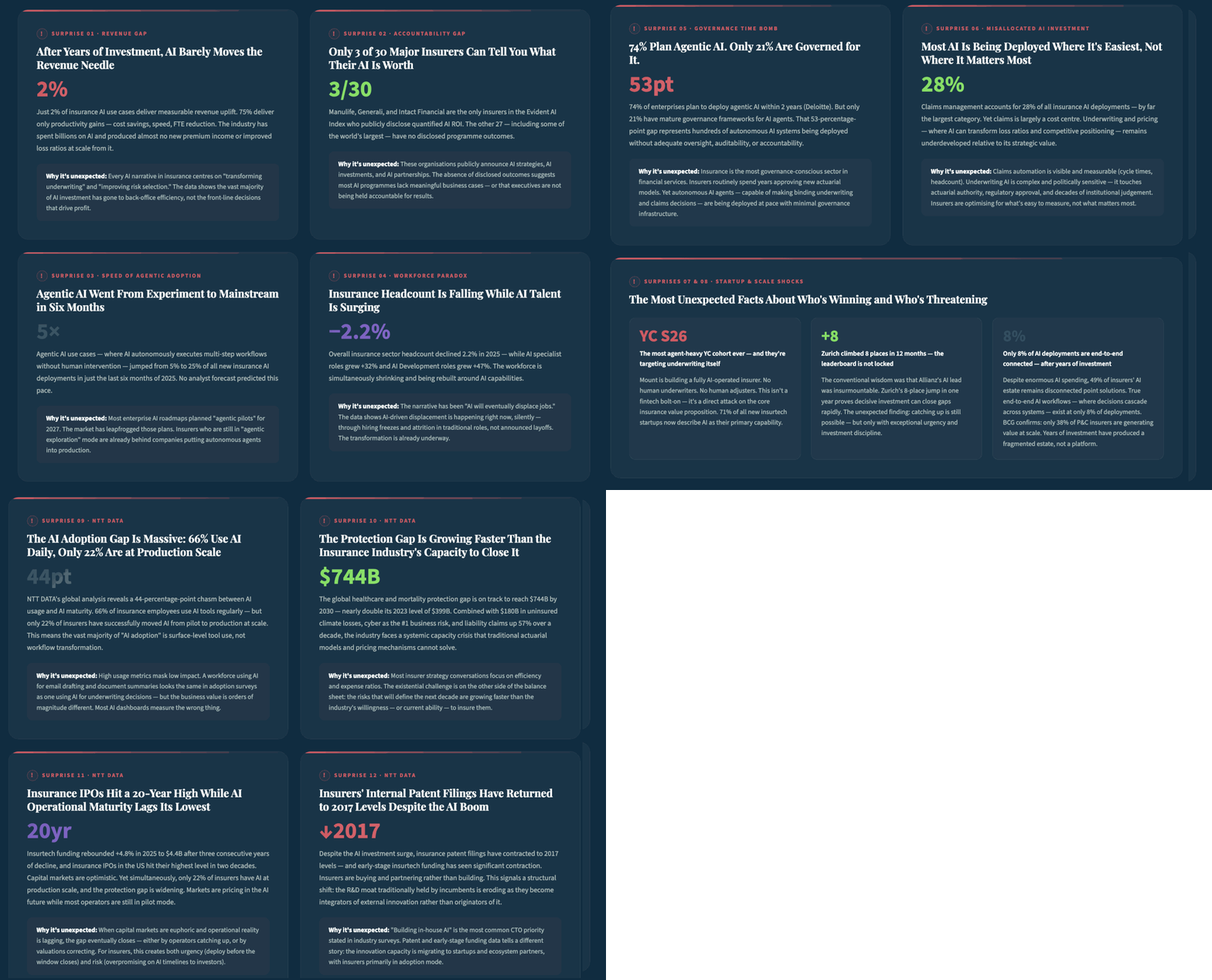
Speaking of reports, there seems to be a whole host of new AI and Insurance reports hit the market over the last few week’s. Here are just a few.
I rarely use AI to write this report (it’s my thinking and learning time), but in this instance I took all the reports and passed them through My favourite French friend which summarized the surprising findings as follows (3 slides)
Sticking with learning, my former colleague 🤖 Lee Provoost - CTO over at Flagstone shared this summary and I agree, a great resource on the top 25 AI concepts from Tokens to RAG to prompt engineering, all easily explained with infographics and quick summaries.
I really liked this for my friends Caroline Bedford and Hélène Stanway who took a trip to a museum of failure in france. Reminds me of some of the work the X, The Moonshot Factory do in celebrating failure. I loved comments like this -
The intuition was completely right. The technology worked. The world simply wasn’t ready for it.
As the old saying goes, we learn more from failure than we do success. If only more organizations were less hung up on getting it right first time, instead of learning through the journey.
And finally, another old saying - when the service is free - you are the product!. Here an AI company is sending a team of camera-clad cleaners and a private chef to boot, all wired with high-tech recording apparatus show up at your home.
No this is not the latest edition of Love Island oh a strange realityTV show - but actually working out what folks do day in day to help train the next generation of humanoid robots.
But, there is a catch: this AI company is gathering data to train the next generation of cooking and cleaning robots, and every inch of your apartment is now being recorded.
👀 Quick bites 👀
Privacy has long been dead. Meta accused of more privacy breaches with ai glasses. She Came Out of the Bathroom Naked, Employee Says
Santander goes Open Source - which insurers will follow? - thanks Simon Taylor
🎙️ Tune in 🎙️
Tune in to the latest episode of Unfiltered, with Matt Connolly and I! Shipping is easy, adoption is hard - life in the gap! it seems to be the recurring theme of late.
And thats It! See you next week! 🚀