Listen : Watch : Read #39

🎙️Listen 🎙️
ServiceNows very own Colin Fleming joins Seth Matlins, Managing Director of the Forbes CMO Network to share why he drove a strategic shift from product-led marketing to brand-led, the end of the funnel, the end of vanity metrics, what all marketing—and buying—has in common, and how simplicity can help anchor marketing in times of great complexity. I’m a huge fan of our brand here - so this was great to hear first hand.
📺 Watch 📺
The All-In Podcast Summit is back with another brilliant collection of guests. I’m still working my way through them. I love listening to Demis Hassabis from Google DeepMind - I loved hearing about the The Nobel Prize process and getting to sign the book with all the greats before him. Super cool!. No surprise, this is all about AI from scientific discovery to the future of creativity to robotics.
The Palantir Technologies interview with Alex Karp, was what you’d would expect. There is no denying his passion and he remains unapologetic about his company and its role in the world.
My colleague Daniel Draes at ServiceNow put together a great demo of how our Insurance Claims capability works effortlessly to solve complex workflows. Well worth checking out! Or in his words, explore how to seamlessly integrate deterministic processes with non-deterministic, agentic workflows in ServiceNow using playbooks.
This demo walks through an insurance claims scenario, showcasing how structured automation can coexist with flexible, AI-driven decision-making. Ideal for architects, developers, and product managers looking to enhance workflow intelligence in enterprise platforms. Nice work!
📚 Read 📚
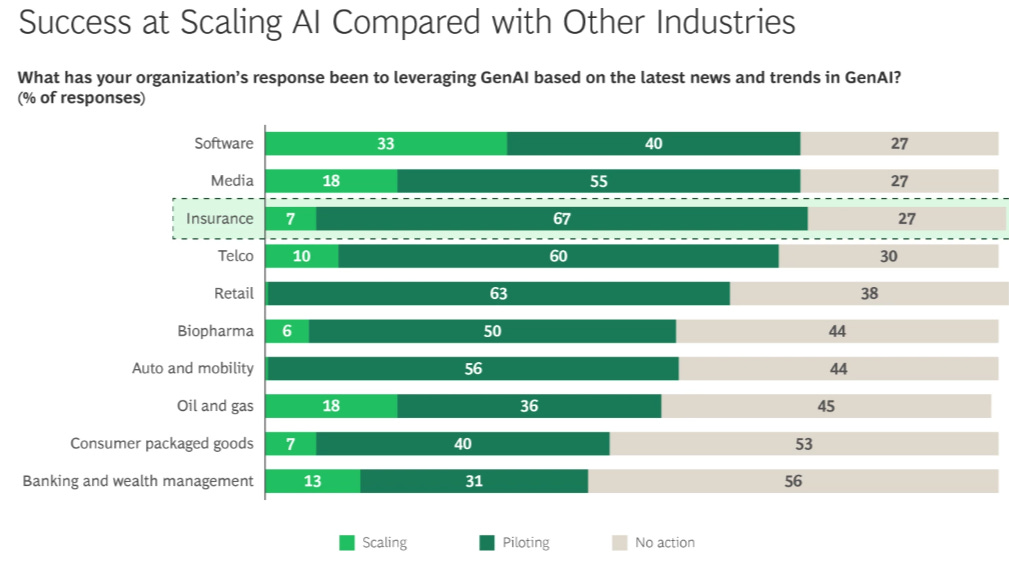
My opening chart comes from this great report from Boston Consulting Group (BCG) - Joe Khoury, Dan Martines, Dr. Christopher Freese, Jürgen Eckel, Malli Gupta and Lara Najjar - counter to other reports shows how Insurance is leading AI Adoption, sitting just behind tech, media and telco
As ever, the debate shifts very quickly to how we now scale! The primary barriers to scaling AI are not technological (accounting for only 30% of challenges), but rather human, organizational, and process-related issues (accounting for 70%). Resistance here still lays within our industries Risk Adverse nature.
As they conclude: The industry’s new leaders will be the companies that recognize AI as a catalyst for fundamental business transformation and are willing to experiment and reinvent themselves.
My friend Rory Yates has pen to paper again talking about the Customer Revolution in Insurance on Insurance Thought Leadership. As with AI above
This shift and the huge commercial upsides that accompany it require a business model and mindset change.
Equally, something Rory and I have spoken on in the past and fundamentally agree on - the need to move from a Product Centric approach to Customer Centric approach is long overdue here too!
Saanya Ojha from Bain Capital Ventures (BCV) talks to how we are drowning in AI Slop!. Highlighting from recent posts from Sam Altman, OpenAI on the Dead Internet Theory. We are being overwhelmed with a volume of low-quality, low-effort content and as a result is polluting the online information ecosystem. It clogs search results with nonsense. Ultimately we need to find a way to restore trust here!
I’m talking a lot about ServiceNow this week, it’s been a big week for us with the Launch of our latest Zurich Release - more info here. Hear from Amit Zavery, our President and CPO directly here. One of the new capabilities that stood out to me was Build Agent, think “vibe coding” meets enterprise rigor. Now, anyone can use natural language to create production-ready apps - like simply asking for an onboarding app that tasks HR, IT, and Facilities.
VentureBeat‘s Sean M. Kerner picked up on this below and in summary - Vibe coding not for hobbyists but for enterprise applications! Excited to see where this takes us next!
Thanks to my friend Kilian Blum for this one. An interesting read in The Economist on Faith in God Like Models may be waning. Patrick Saner, CFA wrote about this too recently. Many organizations are growing more interested in smaller, more specialized models (“Small Language Models”, or SLMs) rather than big, general-purpose ones. For many use cases, a huge LLM with “God-like” capabilities may be overkill. Whereas, smaller models are cheaper, faster, more controllable / tweak-able, and fit more neatly into constrained tasks. Importantly they are optimised for your work as opposed to in many cases, benchmark charts.
Finally, have EV’s have their day! I hope not, but also new data in the USA is showing that Hybrid vehicles are gaining favor among US drivers, and their market share is projected to increase as North American sales of electric vehicles (EVs) are forecast to decelerate, partly due to the easing of US fuel economy rules and the elimination of tax credits for EV.
Goldman Sachs Research now projects EVs to be 25% of global sales in 2030, down from a prior prediction of 28%, though its forecasts for China remain unchanged.
👀 Quick bites 👀
And thats It! See you next week!
This artcle comes at the perfekt time, so insightful! More on agentic workflows?